Showing posts with label RPGs. Show all posts

Thursday, January 8, 2015

Coming Back From the Dead


Coming back from the dead is a major story element in classic fantasy and myth, and is the fodder for entire stories or epics. In 5E D&D, however, it's a rather simple spell with a minor drawback. Since my current world is so heavily inspired by Greek mythology this did not make much thematic sense, so I came up with the following changes to bringing people back from the dead in my game.

Casting Raise Dead does not guarantee that someone will return from the dead. Instead, it allows a group of people, up to five, to have their spirits severed from their body and travel into the Underworld. Once there, they are presented to a judge and must argue the case for bringing their companion back to the land of the living. This usually will require some service to the Gods of Death, the promise of death in exchange, and possibly an extensive quest.

If the judge deems the dead soul unable to return, then the party is not without hope. Once returned to the land of the living, the living companions can sneak into the land of the dead to save their companion. This would require journeying to an entrance, braving the dangers of hellhounds and the River Styx, and hoping their friend hasn't eaten anything while dead.

All in all, it's been a much more entertaining way to deal with death in the campaign thus far.

Monday, April 21, 2014

Old School: 13th Age and a Megadungeon

13th Age OSR?

Recently I picked up 13th Age, and have been playing a lot of it. Like most of the games I have been playing lately, it is very light on the rules and lends itself to some good gonzo action. There are numerous reviews of 13th Age out there, so I wont reiterate what has already been said better by others, I will just state that the game has a very dear place in my heart now.

So of course I want to see what it can do with it. Thus far my games have been in the Dragon Empire (the default setting for 13th Age) with very little customization other than adventure locations. I think it's time to take it a step further and try to bend it.

I'd like to make it more OSR-like. I'm not proposing some major system overhauls, just a few house rules and mainly a change in the way magic items work in order to get that old school adventure feel. I'd also like to throw the characters into a Megadungeon so Rappan Athuk will be serving as the setting for this experiment.


OSR Houserules

The following are a list of house rules I am working on to make 13th Age more OSR-like.

Delving Deeper

Leveling in 13th Age is usually based on DM fiat, but I want to encourage risk vs reward which is a classic archetype of OSR games. I am looking at advancement as a combination of treasure recovered and returned to town, as well as depth the troupe has reached. An idea:

  • X amount of treasure returned grants an incremental advancement.
  • Major encounters defeated grant an incremental advancements.
  • New level delved grants an incremental advancement. This only works for "true levels" not sub-levels.
  • Thoroughly exploring a level grants an incremental advancement. (maybe for sub-levels)
  • Every 4th incremental is a level.
  • Replacement PCs will come in at a level based on depth attained by the party. (2nd level PCs come in on level 3, 3rd level PCs come in on level 6, etc.)
I may have to slow this as they continue to descend, and will be tweaking it probably before we run the adventure. Right now I'm figuring every 3rd true level would be worth a level. Possibly quicker at the top, and slower at the bottom.

Magic Items

In OSR type games, magic items tend to be rare, consumables a little more powerful. 13th Age magic items are potent but not campaign altering. 

  • Scrolls will function with 13th age versions of spells.
  • Not all magic items are created equal. Though I will stick to the 13th Age magical "pluses" some magic items will be stronger than others - A sword of speed might give an additional attack on an even roll, once per round. A vorpal could sever a head on a natural 20.
  • Wands will most likely function once per battle, no recharge roll required, and run out after x charges.
  • Wands, Scrolls will not count toward major item limit, unless the wand is a true implement.
  • Cursed items - need to be nasty.

Danger Level / Sandbox

Rapp Athuk is a dangerous place and I will have the danger levels of the encounters be set based on the dungeon level / challenge of the room. Characters may very well run into things they cannot handle and will need to flee.

Full Rest

A full rest will only be available in town, unless they find a truly safe area that allows them to rest in the dungeon. They will want to return to the town with major money hauls for their incremental advancements, anyway.

Icons

Icons play an important role in 13th Age and I'd like them to take a role in the megadungeon, however the story of the megadungeon is exploration and danger, not so much one icon opposing another. So, I am thinking of the following house rules:

Icon benefits (5's or 6's) can be exchanged for a few different things during the course of a session. It will be up to the player to make sure they get use out of their benefits.
  • 5's: Must be used in town. 6's can be used anywhere.
  • Identify: Your relationship with an icon allows you to identify a magical item you find, and figure out it's command words. Maybe a strange piece of lore or a poem you were told.
  • Clues: The GM can give you clues to solve a riddle, a trap, or locate a secret door.
  • Escape: You can spend an icon relationship benefit to escape from a dangerous situation. 5's can be used to escape, but will cost you 2 recoveries to do so.
  • Healing potion: In town you can gain a healing potion, magic oil or rune.
  • Monster Info: Some monsters require special conditions to harm or have dangerous abilities, an icon relationship can give you that bit of info you need.

Friday, October 4, 2013

Bloodocalypse: Mutations and "Magic Items"

Mutations

Exposure to various mutagenic phenomena may (is going to) happen during the game. Since mutations are a big part of the natural wildlife, I decided to make a system for characters to determine what happens to them when they are exposed to strange energy sources, radiation, rifts in space-time and mutagenic diseases.

Mutation sources will have a Fortitude saving throw DC based on the power of the mutation effect. How much they fail the save by determines the severity of the mutation.

Fail by 1-4: Minor mutation - roll 1d6.
Fail by 5-9: Major mutation - roll 1d10
Fail by 10-19: Severe mutation - roll 1d20
Fail by 20 or more: Extreme mutation - roll 1d20 twice
Natural 1 on save: Roll 1d10+5 three times.

Some mutations will be related to the source of the exposure. Most will use the following table, with the die rolled based on the severity of exposure. Special: a positive luck modifier allows this result to be shifted to the most beneficial within range, where as a negative modifier would shift the roll to the most hindering. Unless stated otherwise the effects of mutations stack and can be rolled multiple times.

Also note that most obvious mutations will add a cumulative -1 to reaction rolls from NPCs.


  1. Tolerance - You gain +1 to saves to resist future mutation.
  2. Susceptibility - You gain a -1 to saves to resist future mutation.
  3. Dangerous Mouth - Your mouth becomes misshapen and filled with sharp teeth. -1 personality, and you gain a bite attack at a secondary action die of 1d14 and deals 1d4 damage. Each time you gain this mutation the damage die increases by one step. You can optionally choose to attack with your regular action die.
  4. Thick Skin - Your skin hardens with strange nodules and scars. You lose 1 personality but gain +1 to your AC.
  5. Mushroom head - Your hair falls out, replaced by strange fungal growth under your scalp. You lose 1 personality but can eat the growths as nourishment, replacing a meal every 1d3 days.
  6. Slimy skin - Your skin becomes slick to the touch, making you difficult to grab. You gain a +2 bonus on any rolls to avoid being held or restrained.
  7. Irritable Bowels - Any time you engage in strenuous activity you must make a fort save DC 8 or have to immediately relieve yourself. Failure to do so results in a -2 to all rolls (attacks, saves, damage, skills) until you do so.
  8. Wasteland Rage - A common mutation in the wasteland. The sight of blood sends you into a fury. When wounded or after seeing blood, you gain +1 to attack and damage for the next 1d4 rounds. During this rage your AC is lowered by 1. You also gain a taste for human flesh.
  9. Minor Body Transfiguration: Roll 1d5 twice. Subtract 2 points from the first ability score indicated, and add 1 to the second ability score indicated. (1-Str, 2-Agi, 3-Sta, 4-Per, 5-Int)
  10. Weakened Bone Structure - Your bones become more fragile, resulting in being much less resilient. You lose 1 stamina.
  11. Rage-Roids - Your body becomes covered in muscle, your muscles have muscles. You grow 1d4 feet in height and double in weight. Gain 1d6 hit points, 1d4 points of strength, 1d4 stamina, but lose 1d4 points from personality and intelligence. If you possess the Wasteland Rage mutation you become more prone to that mutation in the future, replacing the "1-Tolerance" result on the table with "1-Wasteland Rage".
  12. Bug Eyes - Your eyes bulge out and become shiny and gross. You gain the ability to see in the dark an extra 30 feet, but lose 1 point of personality unless you are a Tovi.
  13. Extra Arm - You grow an extra arm from (1d4: 1- Right Side, 2-Left Side, 3-Chest, 4-Back) that can perform actions as an extra action die at 1d14. You need to have your armor specially altered to be able to use it.
  14. Shearing Flesh - Your skin becomes lose on your body, detaching when hit with enough force and falling off in a gross slush of crimson. Any physical wound against you deals an extra 1d4 damage from the torn skin. However, your skin heals very quickly and you recover 1 hit point an hour, 2 if resting.
  15. Deadened Nerves - You lose 1 agility from dead nerves, but your body becomes incredibly resilient to pain. You suffer 1 less damage from all sources.
  16. Thick Nodules - You gain tumor like nodules all over your body, which cause aches and pains. You lose 1 agility but gain 1d8 hit points. Your armor will need to be custom fit.
  17. Major Body Transfiguration: As 9 above, but instead subtract 1d4 from two ability scores and add 1d4 to another. Randomly determined.
  18. Regeneration: You recover your level it hit points per hour. Your skin crawls, and the flesh beneath your skin moves on it's own. If you roll mutation a second time you can reattach severed limbs by holding them in place for an hour.
  19. Giant Brain - Your head swells causing internal bleeding as your skull is forced to expand. You lose 1 stamina but gain 1d4 points of intelligence. You also gain a psionic power.
  20. Extreme Body Transfiguration - Roll 2d3. You can add that many points to your choice of ability scores, but then must subtract 2d4 points from your choice of ability scores.
  21. Or higher - Extreme Evolution: You gain +2 to a random ability score (1d5) and an additional mutation rolled randomly with the same die.

Any sufficiently advanced technology is indistinguishable from magic

One of my favorite quotes, and true for the Bloodocalypse setting. The technology that existed before the collapse of society was so advanced that how it works cannot be explained by even the wisest sage - if Bloodocalypse had sages. No, the tech is just magic. Or maybe magic is just tech. Either way, no one on the world knows. I have four levels of "magical" devices in the setting. First, you have basic utility items. These include flash lights, glow sticks, and other sorts of mundane equipment produced with more efficient technology. These things are the most common (still rare) but a lot more common than than next category. The second group are mostly advanced armament items. These include blasters, laser swords and microweave armors. You also have some of the more advanced utility items at this level. Thirdly we have the very advanced weapons and armor, a lot more rare and more experimental - not much of this left at all. Finally, we have the ultra-tech stuff. This is artifact level tech that will change the entire campaign - from advanced vehicles to self-repairing intelligent power armor and doomsday weapons.

Below are some examples of DCC style magic items made with technology instead of magic.

Healing Goo - Usually contained in metal tubes or small spheres. Once opened, the goo appears to be a semi-solid slime that has the consistency of snot. When applied to a wound it begins working immediately, stopping the flow of blood and repairing the damaged tissue. A single container of healing goo usually has enough material to heal 3d8 hit points before being all used up. Left over from an application can be scraped off and reused another time (the healing is rolled once, and can be doled out in portions).

Blessed Amulet - A strange amulet with a glowing crystal. When the user is exposed to dangerous environmental or psionic threats the crystal glows and surrounds the user with a transparent force field to attempt to weaken the incoming threat. The amulet grants the wearer a +2 bonus to AC and saving throws.

Ceramic Nanomesh Armor - As light as regular clothing, this fine dark grey mesh can be worn underclothing with no problem. The mesh provides the benefits of chainmail armor, without the check penalty, fumble die or movement speed penalties associated with wearing armor.

Blaster Pistol - A large cylindrical barreled pistol with a heavy grip, a loud humming plasma charging chamber, and weird electro-magnetic circuits that glow when active. A blast pistol deals 2d8 damage, and ignores standard armors. Blaster pistols explode on a natural roll of 1, dealing 1d8 damage to the wielder and anyone within 5 feet per charge remaining in the gun - Reflex save for half damage. A blast pistol charge pack can hold up to ten shots, but most found pistols have only 1d4 shots remaining in the charge pack.


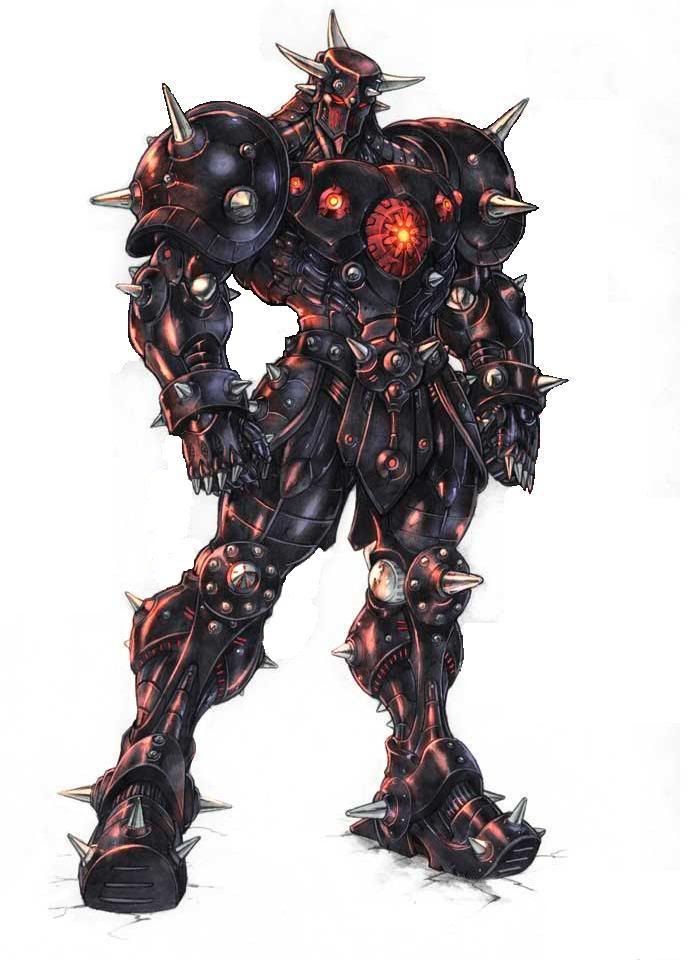
Balefire Power Armor -  Ultra-tech, unique. A set of gleaming dark red armor with spikes jutting from the helmet, massive shoulder plates, wrists, shins, knees and knuckles. A glowing energy core in the chest. This massive suit of power armor requires that the user slip inside of it while it is inactive, and then must bleed into the armor to prompt it to bond with the user - A process which inflicts 2d8 damage to the wearer as a cybernetic link is inserted into the user's brain and spine. After bonded, the armor can be dismissed with an action, causing it to go out of phase with the wearer - effectively vanishing until called on.

The Balefire Power Armor was created with one purpose - to destroy the enemies of the state. However, the state no longer exists. The Armor's intelligent personality causes it to turn it's destructive force on others. Any threat it responds to with extreme prejudice, and seeks to destroy all of the culture remaining on the world. For this reason, the armor is chaotic. It has an intelligence of 20, but rarely chooses to communicate with speech. Instead it uses subtle psionic control over it's user, turning them chaotic and urging them to destroy anything and everything that get's in their way.

The armor is powered with a zero-point energy matrix which gives it near-unlimited power.

  • The wearer of Balefire Power Armor benefits from +13 armor class. The armor has a check penalty of -6, but this does not apply to psionic abilities. The armor does not reduce speed.
  • The wearer benefits from a strength of 20 (+5) while wearing the armor. If the wearer has a strength of 20 or higher already, the armor grants a +2 to strength instead.
  • The armor has a psionic booster circuit, granting the user +2 to psionic rolls.
  • Three times per day, the wearer can use Scorching Ray with a d20+12 on the cast check. This uses the wearers action.
  • The Armor can detect lawful creatures within 100', and illuminates them on the heads up display. Non-lawful creatures can be detected at 50'. This gives the wearer a +2 bonus on rolls to notice ambushes and initiative rolls.
  • The armor repairs any damage to itself at a rapid rate of 2d8 damage per turn. This does not heal the wearer.
  • Energy weapons held by the wearer can draw from the suit's unlimited power supply, supplying them without using charges from the weapons own power source.
  • The wearer's unarmed attacks deal damage as magical warhammers, inflicting 1d8 damage plus strength bonus.
  • The ways of destroying the armor are mysterious.
Goals and motivations: As stated above, the Balefire armor seeks to destroy civilization completely. To do this, it has access to a special use ability below, that can only be used once per month. The armor chooses when to activate this ability, and not the player.

Ego: The armor slowly takes over the wearer. Each day that the armor is worn, the target must make a will save vs DC 15. On a failure they receive a  cumulative -1 to their next check. Once their will saving throw is reduced to 0 in this manner, any further failures and they are overtaken by the armor. Their alignment switches to chaotic and they seek to destroy the cities of the world. Being brain-bonded to the armor is extremely deadly though, and the psionic control inflicts 1d3 points of intelligence damage a day on the user. Eventually their brain shuts down and they die, and the suit has to abandon the body and de-activate until it is found once more.

Special Purpose Ability: Annihilation Blast - 1/month, the suit can unleash a blast of energy that an fire up to 10 miles away and strike an area with a diameter of five miles, inflicting 20d20 damage to everything in the blast radius. This vaporizes most cities and all unfortunate living matter in the area. Using this ability is incredibly dangerous for the suit, however, draining it's zero-point energy reserves.

Wednesday, September 25, 2013

Bloodocalypse: Session 1

Last Friday I ran the first session of my Bloodocalypse campaign, following some intensive days of working on campaign notes and house rules to get it to be what I want. While the campaign world is not complete, it was ready for the first play session.

For those of you that don't remember/care, Bloodocalypse is the working title for my Gonzo Science-Fantasy campaign I am designing for DCC RPG. A world of barbarians and laser guns.

Things seemed to go great. The group got together and rolled up zero level PCs on the new tables I designed. I created a couple different groups of humans with different racial occupations to help establish the themes of the game. We also used the alternate luck rule I came up with - where PCs are allowed to risk their luck if they start with a 9-12 luck score, which could result in the changing of their luck. This had some very unexpected results.

Out of the 4 characters who risked luck, only one got a positive modifier out of it, the others ended up with negative modifiers. However the unexpected result is that the random events that happened when they were younger, ended up resulting in them having a backstory and there for a stronger personality.

For example, one of John's characters was a vat farmer - they use the old vat technology to grow foodstuffs, that taste horrible. His character had decided he wants to make a name for himself, and went wandering into the Pit when he was young. He decided he would use his personality to get out, and used Personality to pray to the gods for help. It failed. Something attacked him and he woke up near the stairs of the Pit with a hole in his head and no memories of what happened since then. Throughout the funnel he was called "Brain slug guy", and continued to talk to the voice in his head that he thought was god.

The character did not survive the funnel, having a -2 to your AC from a 4 luck with "Charmed House" lucky sign is a bad thing. However he had a blast with the character, and the negative luck "event" gave him something to role-play.

I don't want to get into many details of the session, because I plan to write it up at some point. The general idea is that there characters were chosen by acolytes of the Blood God to be sacrifices in the arena. They fought their way to victory and have earned gold and glory in the process.

This week we plan to have two more players at the table, so we'll be seeing where things go from there.

Wednesday, September 18, 2013

The Fane of the Frog God: Part 2 - Where the Wizard Does Something

When we last left out heroes they were just camping out in the abandoned armory of the subterranean shrine, trying to recover from their pitched battles against the Bullywug forces they had encountered thus far. If you remember from last session, Scott's wizard is having trouble getting off any spells - In fact with one magic missile he burned 6 points for a +6 to his roll, and still ended up with a failed cast (Getting less then 12).

Our cast of characters:

Drake the Moller Mauler - A chaotic dwarf with a penchant to bash out teeth of his enemies and affix them to his shield. Played by Randy.

Farmer, the Witness of Ildavir - a neutral cleric in service to the goddess of Nature. Also played by Randy.

Jess the Thug - A chaotic smuggler turned thief with assassin leanings. Played by Ginger.

The Silent Mage - Wizard bound to the King of the Elf Lands. Played by Scott.

We also had two new zero level PCs join in the session, brought in by Scott. An Orphan boy and a Dwarven Blacksmith - Though these come in a little later in the session.

The party has managed to make it through the night without being disturbed. The Bullywug's must not of thought to check the room full of deadly skeletons for the invaders. Jess pops out of the room to do some scouting and finds the hall empty. The head back toward the altar room where they had found the two potions the previous week. Upon entering the room they encounter five bullywug guards, armed and on the lookout for the invaders who have been slaughtering their kin.

The frog-men win initiative and rush in to attack the dwarf blocking the door. One of them runs to the hall and starts croaking - which the players assume means he was calling for reinforcements. Things can get rough quick. The dice at this point are falling in favor of the frog men. A couple of hits and Drake the Dwarf is down on the ground.

Some quick healing from Farmer saves the dwarf. Jess runs past the group and pushes the door shut, on the next round she quickly spikes the floor infront of the door to prevent the reinforcements from entering right away. The sounds of frantic frog hands hammering at the door are heard.

The battle continues to go poorly for the party. The Silent Mage attempts a choking cloud only to have it fail. Jess goes down a critical hit from a bullywug sword, and Farmer is unable to heal her (failing his roll). The Silent Mage grabs one of the potions that had found and pours it down her throat in time, and she wakes back up fully healed and feeling amazing. The tide of battle quickly turns and they have the four remaining Bullywugs down and bleeding out on the stone floor.

They don't have time for a rest, as the door is hit by a massive thud. The party assumes the frogs have brought a battering ram and quickly prepare spell and blade for the attack.

The door breaks down as a massive bear charges into the room. Surprised by the bear, they quickly recover and Farmer manages to critical on his casting of paralysis, allowing him to paralyze the bear in place, blocking then door.

The Silent Mage spellburns again to recast his choking cloud, and gets a minimal effect - a small cloud of stinking smoke that burns the eyes of the bear. His slug familiar moves into position above the door, to paralyze the next thing through after the bear.

They hear spellcasting behind the bear - it must of been summoned. Then the bear is moved out of the way by an enlarged bullywug warrior who stands ten feet tall. He attacks Jess with his massive sword but rolls a fumble, smashing the blade into fragments. The slug then attacks it, paralyzing it when it fails it's saving throw.

The Silent Mage gets off a spell this time, and with a little spellburn was able to cast a potent magic missile this time - killing a distant relative in the process with his mercurial magic. He fires off six missiles that each end up dealing 1d6+1 damage, splitting them between the big bullywug and the caster - Both targets drop in a scream of bloody eagles (the manifestation of his magic missiles) which also dismisses the summoned bear.

Drake the Moller Mauler smashes some Bullywug face and drops the other combatants with the assistance of Jess. Looting the bodies and looking around, the find two prisoners in the hallway, bound up, that the bullywugs had captured from a nearby town to be used as sacrifices. Vowing revenge, the Orphan and the Dwarven Blacksmith join the party and are quickly outfitted in slimy Bullywug leather armor and given longswords.

They had discovered last session that the main hallway was blocked by fallen rubble, so decided to investigate the doors in the "bathing room" they had found before. Heading back inside they find the room empty, and go to climb the vines to get to the ledges above, and the doors they had seen. Farmer is volunteered to go first - The Silent Mage attempts to cast spider climb on him but only gets to cast that spell with a d14 - and thus fails (The Silent Mage has some of the worst Mercurial magic affects I have ever seen). The cleric makes it up easily, however.

They decide to go up the northern passage where the bullywug crossbowman had been guarding the previous day - and venture down a long hallway with a downward slant. The walls here are etched with images of frogs worshipping a giant frog and killing snakes.

In the next room they find a large room, empty of creatures and a door on the right wall. In the center is a clear crystal fountain with a trio of frogs spitting a stream of water into the fountain basin, which shimmers with the flicker of jewels under the water. The Silent Mage believes it is trapped, but Jess the thief is more interested in the jewels and Drake rushes over to join her. As Jess tries and scoops out some gems with a spear they see the spear melt into nothing - and the fountain chimes loudly, and then begins spraying acid all over the room.

Jess manages to dodge behind Drake before he goes down from the acid. She quickly drags him back to Farmer to be healed and the party waits for the acid spray to stop. Choosing to leave the fountain alone for now they pass through the next door, and out into the hallway on the opposite side of the fallen rubble they had found before.

They discover a set of massive double-doors as the end of the hallway with torches burning on the wall to frame it in flickering orange light. They decide to investigate a side passage first, heading down a hallway and listening at the door - where they hear the sound of water. Opening the door they discover the a massive spawning pool of the Bullywug, guarded by several bullywug warriors. Piles of eggs and tadpools swim in the waist deep swamp water. The room smells of rot and swamp gas.

As the Bullywugs rush the door, The Silent Mage gets an idea and starts prepping some oil. The Blacksmith and the Orphan borrow some of his oil and do the same. Drake blocks the door to prevent any of them from getting in, smashing and killing one with his shield.

Jess joins in the fight when Drake goes down to a bullywug attack. Farmer provides some quick healing and the dwarf rises to push back the frogmen. The trio in the back toss in their burning oil, lightning the swamp gas and soon there is a raging inferno in the room sucking the oxygen out of the air around them. Drake kicks the last frog back into the flame to join his burning companions and young, and they shut the door to let them cook.

With no where else to go, they venture to the large set of double doors. Listening at the door, they hear nothing so open up one of the doors. Inside they see a large chamber with still, brackish water just below floor level - with stepping stones slick with slime across the water to an island with a bronze statue of a frog. Red jewels for eyes the size of saucers, and a pile of treasure between it's feet. A brazier burning hot in the palms of the statue.

Seeing the gold, Drake rushes across the stones but falls into the water after slipping, hurting his back and having to scamper to grab the stones to keep from sinking in his chainmail. Jess dances across the stones and notices some strange greenish nodules smeared on the gold, as if something had been using the gold to scratch off it's skin. However she is more interested in the large gems than the gold, and begins climbing the statue.

The others notice a large dark form rising out of the depths, and then it rises from the water. A huge, hulking green creature with rubbery blister and nodule covered flesh. Sickly yellow eyes and a maw full of jagged teeth. He mauls the Dwarf in an instance, tearing out ribs and tossing his body to the side on the stones.

They know they are in trouble (though they didn't know this was a troll - and I got to say, DCC trolls are nasty) and spring into action. At this point I have to say, the Silent Mage made up for being so terrible at casting spells the whole game. He put everything he had into an invoke patron, and his sword began to glow a rainbow hue - Not knowing what it would do, he passed it off to the Orphan who charged across the stones and swung the sword burning a large chunk of his luck to hit the thing.

It had to make a DC 12 Will save to fail, with a +8 to it's roll. I rolled a 2.

The troll is banished to the elflands for 500 years. A scream of victory comes up from the characters (and the player's alike). They begin going through the treasure they can carry out of the temple, and Drake decides to go exploring a bit. Diving under the water, he discovers a cave. Further investigation and he finds a hidden chamber with more treasure, the lair of the troll as well as a glowing one foot tall golden statue of a squatting frog, and a sheathed sword that seemed to be holding up well in the moisture. He fills his pounches with some gems and gold, and swims back through the water.

Drake discovers when he dives under the water that his fingers have developed webbing and he can swim fast - as well as he does not need to hold his breath. He sets down the statue and nearly drowns on his lungful of water before picking it back up and swimming to the surface.

Investigation of the Sword reveals it is intelligent, and calls itself Ezeral, the Defender of Esterfay. A blade forged to defeat the darkness at the heart of the depths. To bring balance to the world. Sheathing the blade the group heads home for some rest.

They make it out of the swamp without issue, and hit up some shops in town to get armor and weapons for their adventure next week.

Tuesday, September 17, 2013

Campaign Building: Title Needed!

I am drawing a blank on the title of this campaign. I have ideas bouncing around in my head, but I still have not decided the mood of the game. Mainly, I don't know how serious I want to take this. After my blog post I had some friends express interest in the Swords and Lasers campaign idea so I thought I would put some effort into developing the idea and see where it goes. For an experiment I plan to catalogue the development process on the blog.


The level of seriousness depends a lot on my mood at the time. I am currently leaning more toward a very gonzo barbarians and lasers style of game and less of a serious game. I still want there to be a drama, action and danger I just want this to be a game where we can get drunk while playing and it will only get more fun.

Bloodocalypse

The working title at the moment. Some other ideas: Savage Lands, Blood and Rust, Forgotten World, and Spaceships and Savages. Of course the content of the campaign, the setting and the adventures I can run in it are the most important details here I really want a strong name that allows me to convey the mood and themes of the game to the players as well as myself.

Setting Elements Brainstorm

My first step when creating a new campaign - after picking the name if I can come up with one - is to come up with some elements for the setting. This is usually just a brainstorm of ideas that I would like to incorporate into the setting. Not all of these will make the final cut, but may be picked up again later for story ideas. Here we go:

Rusted Cities - The world used to be more technologically advanced. No one knows how to make any of the high tech stuff anymore. Working technology is rare and is usually in serious need of repairs.

Uneducated - Most people are uneducated. Reading and writing is rare. City folk tend to be tradespeople who practice family business.

Life is cheap - The strong take what they want from the weak.

Slavery - Captured enemies are enslaved in the city states. Roaming gangs of slavers prey on the weak.

Magic is real - Magic was discovered some time ago, but comes from an external source. The Gods grant power to a very select group of devote followers. Wizards are rare, and must make deals with exotic beings for their power.

Magic is feared - Common people fear the power of magic.

Falling Stars - Crashed ships litter the world. Crafts from the great beyond which have crashed on the dying earth. Strange alien beasts roam the wasteland. Not common, but they are out there.

The Mythic Underworld - The depths of the earth is a place where the laws of reality are weak. Living dungeons that treat invading people as foreign bodies, with traps and monsters being sent forth as it defenses. Dungeons are born from cracks in the surface of reality. The universal laws are breaking down and chaos is leaking through from another dimension.

Things grow more chaotic - The world is dying, reality is cracking. Chaos is reigning supreme. The forces of law lie dead on the higher planes of battle. The blood of their wars drip down driving the men of the world mad with rage.

The Land is in Flux - Things don't stay where they are supposed to. Distances between places are not set in stone. As more chaos leaks into the world things become fluid. The wastelands grow more dangerous.

The Gods are Petty - The Gods seek worship. They demand strange service. They are not kind to their followers. Wars between religions are commonplace.

Putting It Together

So from the brainstorm we have some common themes. The forces of Chaos are winning in this world. As the world nears it's end, the barrier between the world and other realities are growing thinner. Darkness, chaos and madness creeps in to the forgotten corners of the world.

I really like the idea of there being some great war between Chaos and Law, and the metaphorical "Blood" dripping down on the world is responsible for some sort of growing bloodlust or rage. Maybe there are tribes of barbarian savages that have been taken over by the complete death of law - agents of destruction that seek to tear down the rusted cities, the last bastions of decaying law in the world.

Magic is very rare and dangerous. We can assume that magic is a force of Chaos, and perhaps it's discovery led to the walls of reality originally growing weaker. Now with each spell cast the forces of Chaos grow stronger. The only way to fight them back is with more magic.

Technology will be around. Rusted metal walls, cracked domed cities and non-functional vehicles. What does work will be more valuable than gold in the right hands. Technology and magic with both be feared. Some technology, things that were made to be simple and function for a long time - like growing vats for crops and the like, probably still exist enough that they are in common use. Things like lasers and vehicles are much rarer.

Key Locations

Now we come up with a few locations to incorporate some of these elements in them. I know I want a main city to base this game out of. Playing around with some German words in google translate, I come up with something I like - then mash those words together, remove some letters and come up with our first location.

Rotenstrad - The City of Rust

Rotenstrad is situated along the Blood Coast. The largest inhabited city of the known world. Called the City of Rust by most, named so due to the many abandoned rusty metal towers and collapsing metal walls of the old city. The city is sprawling, and has long ago outgrown those old walls. Most of its inhabitants live in squalor under the dangerous red-orange glow of the sun. Food is scarce, as the subterranean food farms aren't able to support the growing cities' bloating population. Even with imported foodstuffs people die of starvation in the streets every day.

The city is most known throughout the world for it's famous Arena of Blood. Where slaves, prisoners and gladiators battle every day for the entertainment of the populace. Gambling on these events is the main source of entertainment for those who can afford it. The combatants that die are drug off to be made into food for the poor.

Friday, September 13, 2013

Too Many Ideas - Not Enough Time

I would consider myself a pretty creative guy. Sometimes it feels like ideas just keep growing and growing, and I need to get them down on paper before my mind explodes. I get a little obsessive creating a new setting, or an adventure, or a totally new roleplaying system. Sometimes they ideas develop into something I use. Often times they just get forgotten in a notebook. Regardless, I feel better for putting the thoughts down and on paper and allowing my mind to move on to something else.
 
This post is going to be composed of random thoughts on gaming, weird ideas I have and some inspirational pictures found online.


I like the look of this little guy. Makes me think of a gnome. In fact, I would love if this is what gnomes looked like - or some gnome like alternative in my game. Something that looks a lot less human than the standard gnome. It looks friendly, but also alien. Something you could see living in the depths of the earth, inventing weird things and crafting strange magics in the dark. I'm going to call his race the Tovi.
 
The Tovi are distant relatives to the goblins, but also share some dwarven mixed blood somewhere else down the line. They are creatures of the earth, that prefer the deep dark places, and are perfectly at home in the Mythic Underworld. They are generally good natured, yet cunning and mischievous. This puts them at odds with the various other creatures that inhabit the deep dark places.


The Tovi live in very alien labyrinths of their own design. Organic yet crafted, often smoothed stone and metal are used in the construction of their communities. They care less about symmetry, and claim to be "listening to the earth" as they craft, which gives a very chaotic appearance to their tunnels and rooms.

The Tovi live in large communities, from hundreds to thousands in a series of these twisted tunnels and labyrinths. They have a strong sense of community, but their minds are a little bent. Leaving most of them toward the neutral alignment. Lawful members of the community tend to be the leaders and spiritual deacons, where as the chaotic members of the society tend to be the trap-crafters, soldiers and spies that put their bent minds to work to weaken the dangerous other inhabitants of the deep dark.

The Tovi are terrified of the Dwellers in the Dark, and work endlessly to protect themselves from the madness that those beings spread. They construct death-trapped hallways and rooms, lures for the beings of chaos, insulating their community from the rest of the mythic underground.

Perhaps I will stat these guys up as a DCC race at some point in the future. I could see these making interesting additions to a party once contact has been made with a colony of them. They are likely to be the only allies the PCs would find in the deepest reaches of the earth.

Random Setting Idea: Dying Earth and Science Fantasy

A world of laser, sword and spell


I really, really, really want to run a game with a mix of fantasy and sci-fi. Some hardcore, heavy metal themed world of crashed alien spaceships, wicked monsters and barbarians. Barrier Peaks and Cthulhu all over the place. Mad Max with a broadsword, some influences thrown in from Borderlands, Epic Spell Wars of the Battle Wizards and Dying Earth. The idea has my brain simmering with excitement. I just don't know when I will have the time to run this with my current games I am doing - or if I will even have any interest. It's been my experience in the past that players don't like Sci-Fi in their Fantasy.

Oh, and the setting has to have gratuitous nudity and scantily clad female warriors. This is a must.


What happened to this world? Well.. I don't know yet. In my head the world had become very advanced. Similar to the world depicted in the Dying Earth series. The world is near the end of it's life time. Humanity had become very advanced but something has happened - some great disaster or catastrophe. Things have been set back to a much more barbaric time. Magic exists now. Dark things creep into our world through cracks in the fabric of reality. Alien ships have crashed, and some of the high technology functions for those who can hold on to it.

It is a world of conflict and war. A world where the strong rule over the weak. Where magic reigns and life is cheap.

This is a setting I really want to run.

Wednesday, September 11, 2013

Homebrewed Species: The Dwellers in the Dark

They lurk below. Within the realm of the sightless, yet they see all. They are the twisted abominations of the darkest reaches of the world. Where the abyss and earth meet, on the periphery of reality they wait, hungry for the minds of mortal men. Their madness poisons the roots of the earth, allowing their insanity to seep into the world of light above.

I've been trying to come up with a name for the creatures that exist in the depths of the ruins of Esterfay. I would like to share some information here without spoiling anything in the campaign.

When I started making the ruined halls I wanted there to be something very alien, something very old, that were the original architects of the halls. The place would have been basically a giant strip of fly paper for them to catch civilizations in to feed their inhuman hunger.

The weird stuff that exists within the halls is a product of their madness leaking to the surface. Some of the weird things were created by mad wizards falling prey to these dark creature's malign influence. Others were created by the creatures themselves, to lure in the greedy, vain and prideful.

The other reason I made the Dwellers in the Dark? I love Mind Flayers and Beholders, but they are totally owned by Wizards of the Coast. I wanted something that I could call mine. Something I could do anything with and mold into the antagonists I wanted in my game.

Description: The Dwellers in the Dark are a few feet taller than a man, but irregular and slender. Above their shoulders resembles a snakes, long and serpentine, with no disenable difference between neck and head. Eyeless, with a pair of wicked mandibles framing a sucker-faced jaw of many rows of circular teeth. They have four arms and two legs, their shoulders and joints pointy yet thin. Their skin is scaly and slick, often colored pale white, indigo or other bizarre, unnaturally bright or pale colors (Weird Lizard Colors). They dress in robes most often, but the more martial members of the race wear strange proto-organic armor that makes them blend in with the darkness as they move.

Combat and Powers: I don't want to get too much into this, for fear of giving too much away. The Dwellers are very strong physically, but often prefer to use their potent magical abilities on their victims. One such power they have developed is a powerful defense mechanism. They can force their skin to flicker brightly, emitting a blinding hypnotic flicker of light that causes sighted creatures to make a will save or become paralyzed by their own nervous system going into shock.

Some sample magical abilities, in no particular order: Charm Person, Command, Paralysis, Sleep, Detect Magic, Invisibility, Spider Climb, ESP, Magic Missile, Lightning Bolt, Magic Shield, Teleport

Of course, individual powers will vary.

Servants of Flesh and Spell: The Dwellers in the Dark make things. Spell and flesh woven together to create servants to enact their will upon the sighted world above. They make their madness manifest in an assortment of ways, and no two things are exactly the same. That said, they have some "common" creations that they use to serve them.

  • The Sightless Hounds - Pale slime skinned hounds the size of a horse, that can run down prey for the Dwellers. A single pack typically serves a single Dweller. They are deadly, with a poisonous bite and vicious claws. Many appear mutated in strange ways - faces on their hides that scream in pain and beg for death; tentacles covering their hide, grasping and pinning those they fight; or strange appendages and spikes.
  • The Crawling Madness - Deadly worms that first appear as tiny parasites too small to see. The Dwellers have released these parasites into much of the drinking water, and they can also be transmitted via bodily fluids. An infected individual first appears to have their eyes "Swimming with madness" as the worms multiply quickly in the body. They grow stronger, gaining bonuses to their strength and stamina, as well as growing smarter, gaining bonuses to intelligence. Their bodies begin to mutate as the worms reweave their flesh from within. Soon, they become so insane with bloodlust that they attack on sight anything that is not under the control of the Dwellers. A rare few will be chosen by the Dwellers to undergo the Apotheosis, and be transformed into Dwellers themselves.
Just some teasers. Maybe it's too much?

Back Gaming!

I'm back in my hometown with the old crew and getting some games going. I am currently running two games, and thought I'd share some of what is going on.

Ruined Halls of Esterfay

Started a new group to DCC, and decided we would play in my Ruined Halls megadungeon with a couple of sandbox adventures in the area around them. They are given the freedom to do what they want, chasing down adventure leads or plumbing the depths of the megadungeon for their riches.

The first session was the character funnel, where the players each had four 0-level characters and went through "Portal Under the Stars" the DCC introductory adventure in the book, which was also the first adventure I got to play when my friend Kevin introduced me to the game.

They had a blast, and the death toll was high. My friend Randy, new to DCC but has been playing with me since the 80s, lost all of his characters. Ginger, also an old friend of mine but new to DCC as well lost all but one. On the next session we had another player join us, Scott, who rolled up a wizard with the worst mercurial magic effects I have ever seen.

Randy rerolled a set of characters, I allowed him to pick two to level to first level - He chose a dwarf and a cleric. The party then met up in the Wanton Wench, a bar in the city of Loris that caters to treasure hunters. They listened to some rumors of wealth and opportunity, and decided that they should check out the frog men of the swamp to the east that have been attacking villages.

The ventured to a town on the edge of the vast swamp. Really just a couple of families living close enough together to be called such. They met a farmer who had been attacked by one of the frog men.

He had seen them rooting through the abandoned farm next to his own, and the next morning they came to his place. He caught one in his barn, tried to drive it away and it drew a sword and ran him through.

The party, armed with the knowledge that the frog men had weapons, went to investigate the old farmhouse first. They discovered it had been stripped of anything of value, and even had boards taken from the walls. with more questions than answers they pushed forward into the swamp.

I would like to point out here that this is a random adventure I created by rolling a couple of dice of a random adventure name table and coming up with the adventure from there. This adventure is titled "The Fens of the Frog God".

In the swamp they quickly got lost, but since they didn't know what they were looking for it didn't matter. A couple of hours later and I rolled up a random encounter. While passing through a treacherous section of the swamp they are attacked by waterlogged bloated corpses.

The party quickly pulled up to some nearby dry ground to defend themselves. The battle was pitched, but they came out victorious. This is the first time that Scott's wizard got to cast some spells - One of the things I have been doing lately is rolling up the mercurial magic effect the first time the spell is cast - So it's a mystery until the wizard finally unleashes the spell. Scott discovers that every time he casts magic missile someone he knows dies! Lucky for his friends and family he can't manage to cast the spell without failing.

The cleric (who's name is Farmer - Randy says his father had a sense of humor about it) attempts to turn the undead with the power of Ildavir, and fails. His second attempt even nets him disapproval, forcing him to have to pray for ten minutes following the combat.

The thief Jess, played by Ginger, and the dwarf - Who's name is currently escaping me, both make quick work of the zombie horde, though are seriously wounded in the process. Jess falls unconscious and loses one of her daggers in the high swamp grass.

After dispatching the last zombie and healing they decide to press on a little more before resting. The cleric conjures forth a feast for them all, scoring a critical on his cast and summoning a feast to feed over a dozen people. They leave the remaining food as bait for wandering monsters and find somewhere out of the water to rest.

Camping on a wide fallen tree, they manage to make it through the night without any further incidents. The next day while traveling they spot a massive twenty foot tall elf in the distance, wearing leather and moving silently. They fail to hide and the thing approaches, demanding that they explain themselves.

Only the cleric in the party speaks elvish. There was a level 0 elf traveling with the party as well, but he was too stupid to speak his own language.

After some quick banter with the giant elf, they learn that the giant is hunting a dragon. He tells them where they can find the bullywugs they are hunting, and tells them they have recently moved in to an abandoned temple in the swamp. They thank the giant, and the they go their separate ways.

They reach the mound of  the temple entrance. Descending the tunnel, they find the central entry chamber is a below ground garden full of frog topiary hedges. A fountain in the middle is full of glowing mushrooms. A trio of the bullywugs is here, and leap to attack.

The battle is deadly! Both of the random zero level dudes go down to the bullywug's blades. Jess the Thug gets to ambush one of the frogs and slays him. The wizard drops to a flurry of blades and nearly bleeds out before being saved by Farmer. They finally stand triumphant over the mutilated frog corpses. They find that the frog men have a surprising amount of treasure on their persons, gold, silver and even a gem. One even has a piece of platinum. There must be more treasure within! They pass through the double doors to explore further.

The main hallway goes a good distance before splitting. Evidence that the tunnel had collapsed before is found, and a large section is still blocked off. They find some side passages to explore. In the first room they encounter a group of frog men bathing in slimy knee deep water. They do not have their armor, but the frog men seize initiative and get to their blades. A fourth bullywug peeks out over a ledge along the wall and begins shooting his crossbow down into the group.

This battle goes much better for everyone but the wizard, who continues to lose spells and fumbles with his blade. The dwarf has now taken to calling himself "Moller the Tooth Smasher" as he uses his warhammer and shield to smash the teeth out of everything he fights. After killing the frogs they discover two more passages out of this room, both up off the ground level but decide to go back to the other passage they discovered off the main hall.

This room has a pair of bullywugs speaking in croaks, standing near a blood soaked altar. The room filled with columns. The party does not give them a chance to attack first, and rushes them down. Killing these two easily. Searching around they find a secret compartment in the altar, that contains a few coins and a wooden box with two potions.

Note: I use a special system for potions in my game. Different potions can be identified by their characteristics. This is just an example, but a healing potion might be a golden thick liquid with swirls of red color, that smells of lavender and tastes sweet. They would then know that any potion matching that description would be the same type of potion (though there may be different looks to the same potion - and some poisonous liquids may be improperly brewed versions of that potion).

After some discussion they decide to not try the potions unless they are desperate and proceed on through a door in this room. They find another hallway heading toward the collapsed section of the temple, as well as a door marked with a red x. They investigate, discover the door is locked and open it up anyway. Inside is an abandoned armory filled with rusted weapons, armor and piles of bone. They step inside and the bones start to rise, forming into frog-men sized skeletons.

They rush in and battle, Moller the Toothsmasher leads the charge with a bulrush and a tackle, taking out two of the skeletons in one go. The third one falls to the thief with a warhammer, and the others get turned and backed into a corner where they crush them into piles of dust.

They decide that his might be a safe place to rest, since the frog men obviously don't come in here anymore. They close and lock the door, and prepare to sleep.

End of session two.

We play again next Monday, so I will give you all an update then.

As far as my second campaign I am running? I will save that for another post.

Ruined Halls of Esterfay: Strangeness in the Megadungeon

As I return to playing my campaign and dust off the binder containing the dozens of pages of megadungeon maps and notes, I remember all the cool random things tucked away in the dungeon that the players last time through got to see. There were also countless things they didn't get to see, because that's just the nature of a megadungeon. When you're first dungeon level has six hundred rooms the players are going to skip over a few things.

I thought I'd share a few of my weirder things here. Maybe someone can borrow something and put it to good use.

The Fountain of Youth and Beauty

I love making dangerous fountains. Just something about a beautiful fountain in a cursed and deadly place makes me cackle like a mad man. I think it goes back to when I was young and first read the Dungeon Builder's Guidebook. There was this excellent picture of a group messing with a fountain and getting sprayed with deadly acid. That has always stuck with me, and perhaps makes up a core of my being.

A large chamber somewhat near the entrance of the dungeon. On the walls leading up to it, the kobolds that live in the area have scratches warnings to their fellows into the wall. The players might see the two foot high cross scratches by the time they hear the fountain bubbling and splashing.

The chamber lights up when light is brought inside, reflected upon the perfectly polished mirrors that line the walls. There is a wide hall exit from the four cardinal directions of the room. There is also a 1 in 6 chance of there being a skeleton or rotting body laying next to one of the mirrors, but the giant rats and slimes that clean this section of the dungeon usually sweep through here for an easy feast.

In the center of the chamber is a massive fountain of polished white marble. A statue of a maiden with a strange looking face- vertical eye slits, fanged mouth and naked - sprays water from her outstretched hands into the pool around her. The water shimmers clean and bright. A few coins sit on the bottom of the pool, from countless travelers making a wish.

Effects of the Fountain

Drinking from the fountain has a variety of effects. Failing a charisma/personality test causes the character to gain a point of the stat. Their ugliness fades, wrinkles and scars vanish and they just radiate attractiveness.

Succeeding on the roll does not grant beauty, but it does grant youth. Restoring a lost year to the character from a sip, making them younger.

Either way, a character that drinks must make a saving throw (will in DCC) to avoid drinking again. In my game the DC was 15, +2 for each drink the character has had. Failing causes the character to become addicted to the beauty they can receive from the fountain and gorge themselves on the water. Unless physically stopped from drinking (and they will fight to drink) they will unmake themselves in a matter of minutes.

After drinking, even with making a save to resist drinking again, the character must make another will save to leave the room, failure meaning they stop to stare at themselves in any mirrors they pass (remember the walls here are also covered in mirrors). They will waste away staring at themselves in the mirror, their vanity becoming so great they wont eat or drink anything for a week save for staring in any available mirror.

Mimics in DCC - AKA Dwarfbane

In Dungeon Crawl Classics, the dwarf has the ability to smell gold at a distance of up to one hundred feet. As I thought about the monsters that might inhabit my megadungeon, I thought about what sort of evolutionary changes I could make in a classic monster to make it fit into the setting. I always loved mimics, and somehow this idea popped into my head: Mimics love the taste of dwarf flesh.

Mimics in my world have developed the ability to smell like gold to a dwarf. Each one is born with a strange cluster of gold in an organ in their body. They can "flex" this muscle to emit a potent waft of "gold smell" out of their body. They often incorporate gold into the camouflaged forms they take when laying in wait for food.

This has led to some interesting encounters with mimics, when the party allows the dwarf to lead them around by his nose.

Sunday, June 24, 2012

About Random Encounters

I like random encounters, especially when playing a dungeon crawl game. I think the unpredictability adds a sense of suspense to the game. The players realize their character's could encounter something at any moment. While thoroughly searching the walls of a room for secret doors someone needs to stand watch at the door just in case something wonders by and hears them. It adds to the immersion level by letting the player feel some of the anxiety their character should be feeling poking around in a dusty maze all day.

I use the same rules for random encounters regardless of what game I play, but have some added house rules here for DCC RPG that I will include for posterity. Most of these rules never come up at the table, and are mostly just internal guidelines I use when running the game.

Time Keeping in DCC RPG

  • One round of combat is 10 seconds. 
  • One turn, is six rounds, or 1 minute. 
  • A random encounter is checked every 10 minutes (Mostly). 
  • Main hallways are checked more frequently (5-8 minutes). 
  • Extents of large dungeons are checked less frequently (15-20 minutes).
  • Searching a 10 foot section of wall for secret doors or the like, takes 2 minutes.
  • Searching a rooms contents takes between 2 and five minutes, depending.
  • While not fighting or fast walking, real time equals dungeon time.
  • After a fight, characters take a turn to drink some water, bandage wounds, etc.
  • Moving down hallways takes real time, or 1 minute per short section if actively searching for danger.
  • After an hour of play, torches need to be replaced (I need to remember to enforce this more often).

Checking for Encounters

I use a very simple system for checking for encounters. I roll a 1d6. On a 1-2 (33% chance) there is a wandering encounter. On a six, (16% chance) There is a special chart I use that includes: Random sounds in the distance, clues left on the ground, rubble or fecal material, tracks, etc.

Creating the Encounter Table

When creating the random encounter table for an area, I first look at what sort of things might be wandering the halls. This helps me not only have reasonable encounters, but can give the players clues to what else might be lingering the area they haven't encountered yet. I will usually use a percentile die, and assign creatures based on how big their community is in the area, and how mobile they are. I will also include a few listings from areas a bit further away, and then throw in a few dungeon classics like oozes. I will have a few wild cards from deeper in the dungeon, but usually only near the main passages or in an area containing a passageway that leads deeper.

Creating the Random Events Table

Think of sounds the characters might hear based on the area they are in. If there are doors that need to be opened to get around, make sure you have the sounds of doors slamming, creaking of wood or the grinding of stone in the distance. Screams, sounds of combat, and strange babbling can all add the theme and mood you want to portray in the underworld of a dungeon. In nature settings this gets even easier to come up with, and can lead to a very immersive experience. This table can also be an excellent place to stick the weird stuff you would like to include in the dungeon. In my megadungeon I have a few magical events that are triggered by this table.

Advice for 0-level Character Funnels

Posted an advice article over on rpggeek on designing 0-level character funnels that has received some positive reviews, so I figured I would re-post the information here on my old blog that I never use. This is an attempt to resurrect my writing and channel some of my creativity.

Rule Number One - The players should be given opportunities to kill themselves.


This means that you do not put in a slew of death traps, or make deadly encounters that are necessary for progression. Deadly things should definitely be in the adventure, but they should be the player's choice. You should always keep risk vs reward in mind.

For example, the game in the post above the players did not know when the riders would be returning that they saw leaving the fortress. They did not know how many more would be in the fortress. If they had tried to jump in front of the speeding horses it would of cost them severely. Instead they chose to wait for hours for the riders to return, setting up some traps and hoping that another patrol did not ride out in the meantime.

Later, with the encounter with the Big Bad Goresnatch, they decided to pour the holy water on the queasy symbol they found, instead of just leaving. They decided to close with Goresnatch instead of trying to outrun him.

In most trap based 0-level funnel adventures I have ran, there is always some player dependent trigger for the traps, and always clues planted around the room for answers. The tomb of a saint allowed single people to pass through its halls, as single people are not likely to be thieves. If more than one person walked down the hall at once, the traps would trigger.

Some of my standbys I like to use: Intimidating statues holding weapons, treasure on display, damaged bridges over gorges as shortcuts to avoid monster infested territory, glowing archways of magic, levers inside of a statue's mouth. Not all of these are always bad, and when you keep the players guessing you keep them interested.

Rule Number Two - Player Choice is essential


Players like to feel that their actions have meaning. So try to design your adventure with problems without necessarily setting the solution in stone. In a dungeon, give them different directions they CAN go, not directions they MUST go. Give them options to try to avoid fights or traps, but put rewards in place as carrots to draw them in. Let them decide if that gold chalice on the pedestal is worth braving the intimidating iron statue with a sword in the corner of the room.

Even when designing puzzles, you should always leave room for the players to come up with their own solutions. They might not see the solution you came up with, but if they come up with a something that is acceptable you should let it work. The best thing is when you don't even tell them that you "gave in". That would ruin their sense of accomplishment.

For death traps, always leave clues that there might be something odd about the room. I never have truly "empty rooms" in my dungeons. There is always something in a room, be it broken furniture or whatever. Actually, that will be a rule further down (See below). Back to death traps, if you have such a thing (which you really don't need in a 0-level funnel. I have found that a d6 damage is usually enough to kill most characters), you should leave clues.

If a room is empty save dust on the ground and small bits of rock. They look around and notice stains on the ceiling and marring on the stone. The players may realize that something in the room might crush them, if they don't and step inside, you should feel that you gave them plenty of warning and left their fate in their hands.

Rule Number Three - Scale is important


Like older editions of a certain fantasy role-playing game, there is no set difficulties for DCC levels. I try to make my games sandboxes, but when it comes to the funnel you need to consider that some of these PCs need to survive. Through play, I have figured out the following rules of thumb when it comes to setting HP, DCs, damage, etc.

0-level characters will generally have 2 HP, 9-11 AC, 0 to saves, and 0 to hit.

This means that for every one point over 10 you raise a challenges DC, you will probably kill a character.

So, if I have a challenge that is required, I generally set a DC of around 10-12 if the players do it without thought (jumping over a gorge). Or 5 if they put thought into it (Hammering some spikes in the wall and using a rope to get across the gorge). This allows me to stay true to rule number 2, even with required challenges.

For optional challenges I like to sit at that 10-12 range, with failure resulting in 1d6 damage. For traps, this sets the DC at 10-12.

A sub rule to this, is that if something makes sense and there is no drawback to failure.. Don't bother rolling dice. If the PCs think of a clever way to disable a dragon statue breathing fire on them, then don't make them roll dice to do it. If they avoid the trigger then they outsmarted the trap.
During the course of a funnel I tend to offer chances for the remaining PCs to grow a little stronger. They can take armor from dead enemies or find weapons in an old chest. I tend to limit myself to the following:

Padded or leather armor. With one or two sets of studded, and if there is some severe challenge, then it could possibly have scale or chainmail. Usually if I give these "better" armors, I will say they are rusty or damaged, and have them have a steeper fumble die until they are repaired back in town. (Once again, putting the risk vs reward choice in the player's hands)

I try to limit weapons to the d6 level during the funnel. With some better ones as rewards at the end. I do this to keep the characters trading weapons until they find what they like, and it keeps damage in the range of one or two strikes to kill.

Your Big Bad, whether it's a monster or a challenge, should be two to three times as difficult as anything else in the adventure. This will be the thing that finishes off those last few level zeros, and will leave the survivors feeling like they are destined for greater things.

Rule Number Four - Think of the future or add in that planar weirdness early


These zero-level characters may be farmers and gravediggers now, but after this adventure they are supposed to be classed heroes. Although the game is very gonzo, I like to keep some sense of realism in my game. So I always make sure to include a few things in my zero level funnels to allow players to pick certain classes if they want.

Clerics - I try to include some supernatural/undead/holy area in my zero level adventure that allows the characters to either feel the danger of the other worlds, or feel peace and security because of the Gods. In the adventure linked above one of the PCs used his family holy symbol to try to turn Goresnatch the demon-thing. They also destroyed his magic with holy water, and also restored a desecrated temple.

Wizards/Elves - Wizards in DCC aren't exactly the learned scholar types of other games. They tend to be power hungry warlocks that gain their knowledge from other places. I try to include some source of magic in a zero level funnel to make a wizard career more plausible after the adventure. In one adventure I had a tomb bound in flesh, when the elf and another PC (who was thinking of being wizards) touched the book, the ink ran off the pages and was absorbed into their skin. In the above adventure, they shattered a dark glowing jewel in the desecrated temple. The PC that kept the jewel to study it felt whispers in his mind opening himself up to offered power.

Warriors and Dwarves - They need an opportunity to get a few nice weapons and at least studded leather armor. Combat, if any existed, will probably help those that want to be warriors decide on this career.

Thieves - I find that 0-level funnels always tend to attract a lot of thieves in the group after the funnel is over. For some reason people like sneaking around and not getting killed after being through my funnels, I wonder why? (Evil Laughter)

Rule Number Five - Room Design, never leave an empty room


Rooms need to have contents. In your house do you have any room that is truly empty? Why would someone dig out hundreds of cubic feet of stone to not use the room for anything?

Most rooms served a purpose. Even if we're running some weird astral-demi plane dungeon that was created by a mad wizard, he did not leave any of his rooms empty. Even in my megadungeon that has 600+ rooms on the first level, I don't have empty rooms. There may be just some trash or broken furniture, but at some point that room was used for something.

By not having empty rooms, you keep your players guessing. They don't know what room will contain monsters or hidden treasure or traps. All they know is that this room has some barrels and spider webs, and we need to search it to see if there is anything of value.

Rule Number Six - Give them somewhere to go


This rule is important for both the beginning and the end of the funnel adventure. Most of the occupations assume a small to moderate sized town. These are places that are great to start your funnel, but shouldn't be where the funnel ends. These characters need to go out and become adventurers. Give them some place that is just beyond where they have ever been. A mist filled forest twenty miles out of town, or an old keep on the other side of the lake. It should be close enough that the characters can be familiar with the area, but far enough away that they are leaving the comfort zone of the town.
When the adventure is concluded they should have some reason to move on and continue to adventure. Without this reason, what is to prevent them from going back to their old boring lives? You gave them a taste, give them a hint of even greater glories and treasure and send them on their way.

So, that's about it for zero-level funnels. I think the main thing to remember is that you want to kill off 75% of the characters, but do it with player choices in mind. When the halfling goes out to collect firewood he gets caught in a giant spider web. When a farmer bulls a lever he gets sealed in a room. Put clues there and danger and watch them kill themselves.

I think this is very important in zero-level funnels, it sort of makes a silent agreement between you and the player. They know there is reward there associated with risk, and if the risk the characters they want to keep they are inviting loss. If you just kill them randomly, they will quickly lose interest in the game.